- Todos los productos
- Todos los productos
- Hydrophilic PVDF Membranes
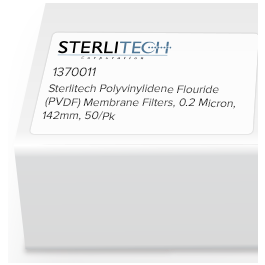
Hydrophilic PVDF Membranes
 https://www.cotecno.cl/shop/hydrophilic-pvdf-membranes-629458
https://www.cotecno.cl/web/image/product.template/629458/image_1920?unique=24ae11f
https://www.cotecno.cl/shop/hydrophilic-pvdf-membranes-629458
https://www.cotecno.cl/web/image/product.template/629458/image_1920?unique=24ae11f
Descripción general
Hydrophilic PVDF Membranes
PVDF membranes do not require the use of wetting agents, transmitting negligible extractables and increasing sample purity during sterilization or clarification procedures. Because of their exceptionally low protein binding levels--even lower than similar nylon, nitrocellulose, and PTFE membranes--our PVDF filters are well-utilized in the preparation of proteinacious solutions for chromatography and other instrumental analyses. Broad chemical compatibility allows these PVDF filters to accommodate a wide range of applications--especially those requiring high flow rates/throughput--including aggressive/non-aggressive acids, alcohols, and solvents in mobile phase. Our versatile PVDF membrane filters are available with pore sizes of either 0.22 or 0.45 μm; however, the 0.22 μm pore size is preferred for the removal of uHPLC contaminants most likely plug columns and damage analytical results.
We provide the filters and technical support to help you take your breakthrough product from an idea to a prototype, to commercial scale.
Preguntas frecuentes
The pores of microporous membrane filters act as small capillaries. When hydrophilic membranes come into contact with water, capillary action associated with surface tension forces causes the water to spontaneously enter and fill the pores. In this manner, the membranes are easily wetted and allow the bulk flow of water through the pores. Once wetted, hydrophilic membranes will not allow the bulk flow of air or other gasses, unless they are applied at pressures greater than the membrane’s bubble point.
Hydrophilic membrane filters are typically used with water and aqueous solutions. They can also be used with compatible non-aqueous fluids. Hydrophilic membrane filters are typically not used for air, gas or vent filtration since the filters would block flow if inadvertently wetted, by condensation for example.
When hydrophobic membranes come into contact with water, surface tension forces act to repel the water from the pores. Water will not enter the pores and the membranes will act as a barrier to water flow, unless the water is applied at pressures greater than the membrane’s water entry pressure. Low surface tension fluids, such as alcohols, can spontaneously enter and fill the pores of hydrophobic membranes. Once all the air in the pores is displaced, there are no longer any surface tension forces and water can easily enter the pores, displace the low surface tension fluid, and pass through the membrane. The membrane will then allow bulk flow of water for as long as the pore remain water filled. If the membrane is allowed to dry (i.e. air enters the pores), then it must be pre-wet with a low surface tension fluid again prior to use with water.
Hydrophobic membrane filters are typically used with compatible non-aqueous fluids. They are also commonly used as air, gas, or vent filters. Hydrophobic membrane filters are sometimes used with water or aqueous solutions; and, in these applications, they must first be prewet with a low surface tension, water miscible fluid prior to use.
Nominal pore size ratings are provided as a general indication of filter retention. It is understood that some quantity of particles greater than, and equal to, the nominal pore size ratings will pass through the filters into the filtrate. Some manufactures may associate nominal pore size ratings with percentage filtration efficiencies. Nominal pore size ratings vary from manufacturer to manufacturer and, consequently, are not necessarily equivalent. Filters from different manufactures with similar nominal pore size ratings may not actually exhibit similar retention characteristics.
Absolute Tamaño de poro ratings are typically based on retention studies performed using challenge suspensions of standard microorganism cultures or particles of known size. Absolute Tamaño de poro ratings represent the size of the smallest microorganisms or particles completely retained during these studies. Absolute Tamaño de poro ratings are almost always correlated to bubble point Especificaciones that are used for quality control during membrane manufacturing. For the most part, absolute Tamaño de poro ratings, especially those based on microbial retention, are comparable from manufacturer to manufacturer. There is more uncertainty for absolute Tamaño de poro ratings based on particle retention studies, especially for Tamaño de poro ratings <0.2µm, since there are no standard methods for these studies.
Regardless of pore size ratings, it is important to understand that application conditions do influence particle retention. Even filters with absolute pore size ratings can be operated in conditions that will allow unexpectedly sized particles to pass.
The Tamaño de poro refers to the diameter of the individual pores in a Filtro de membrana. Tamaño de poro is typically specified in micrometers (µm). Most membranes and filter media actually contain a distribution of pore sizes. Nominal Tamaño de poro ratings typically refer to the predominant Tamaño de poro of a filtration media; pores larger and smaller than the nominal rating may be present. Absolute Tamaño de poro ratings typically refer to the largest Tamaño de poro of a membrane and it is expected that all pores will be equal to or smaller than the absolute rating.
For the polycarbonate track-etch (PCTE) and polyester track-etch (PETE) Filtros de membrana, porosity is the percent of the total surface area occupied by the pores; it typically ranges from <1% to 16%. For the other Filtros de membrana, porosity is the percent of the total volume occupied by the pores; it typically ranges from 40 to 80%.
The bubble point is the minimum amount of pressure required to push air bubbles through the largest pore of a wet membrane. The bubble point is inversely proportional to the pore diameter, as the pore diameter decreases the bubble point increases and vice versa.
Retention efficiency of Filtros de membrana can be directly measured by challenging the filters with suspensions of standard microorganism cultures or particles of known size. Unfortunately, such efficiency testing is necessarily destructive. However, since retention characteristics are dependent on Tamaño de poro, it is possible to correlate destructive challenge testing results to non-destructive membrane bubble point tests. In this manner, the relationship between membrane Tamaño de poro and membrane bubble point is empirically determined. Typically, a minimum bubble point can be determined and specified for a particular Tamaño de poro rating. The bubble point Especificación is then used for quality control during membrane manufacture. The bubble point can also be used by the consumer as a nondestructive test to verify membrane integrity before and/or after use.
Depth filters are constructed with relatively thick filtration media and typically have nominal Tamaño de poro ratings >1µm. Due to their large void volume, they capture significant amounts of particulate within their pore structure.
Filtros de membrana are typically composed of polymers that have been chemically processed, resulting in highly porous thin films with microscopic pore structures. Filtros de membrana typically have absolute Tamaño de poro ratings <1µm, with some exceptions. Because of their very fine pore structure, Filtros de membrana tend to trap the majority of particles on the surface. However, smaller particles with diameters near or below the Tamaño de poro rating can be captured within the membrane or pass through the membrane.
| Especificación |
0.2 µm · 13 mm · pack 100
|
0.2 µm · 142 mm · pack 50
|
0.2 µm · 25 mm · pack 100
|
0.2 µm · 293 mm · pack 25
|
0.2 µm · 300x3000 · pack 1
|
0.2 µm · 47 mm · pack 100
|
0.2 µm · 90 mm · pack 50
|
0.45 µm · 13 mm · pack 100
|
0.45 µm · 142 mm · pack 50
|
0.45 µm · 25 mm · pack 100
|
0.45 µm · 293 mm · pack 25
|
0.45 µm · 300x300 · pack 5
|
0.45 µm · 300x3000 · pack 1
|
0.45 µm · 47 mm · pack 100
|
0.45 µm · 90 mm · pack 50
|
|---|---|---|---|---|---|---|---|---|---|---|---|---|---|---|---|
| Tamano de poro | 0.2 | 0.2 | 0.2 | 0.2 | 0.2 | 0.2 | 0.2 | 0.45 | 0.45 | 0.45 | 0.45 | 0.45 | 0.45 | 0.45 | 0.45 |
| Tamano de paquete | 100 | 50 | 100 | 25 | 1 | 100 | 50 | 100 | 50 | 100 | 25 | 5 | 1 | 100 | 50 |
| Diametro (mm) | 13 | 142 | 25 | 293 | — | 47 | 90 | 13 | 142 | 25 | 293 | — | — | 47 | 90 |
| Tamano de hoja | — | — | — | — | 300x3000 | — | — | — | — | — | — | 300x300 | 300x3000 | — | — |
| Ensayo USP clase VI | Passed | Passed | Passed | Passed | Passed | Passed | Passed | Passed | Passed | Passed | Passed | Passed | Passed | Passed | Passed |
| Union proteica BSA | ~4 µg/cm2 | ~4 µg/cm2 | ~4 µg/cm2 | ~4 µg/cm2 | ~4 µg/cm2 | ~4 µg/cm2 | ~4 µg/cm2 | ~4 µg/cm2 | ~4 µg/cm2 | ~4 µg/cm2 | ~4 µg/cm2 | ~4 µg/cm2 | ~4 µg/cm2 | ~4 µg/cm2 | ~4 µg/cm2 |
| Esterilizacion | Gamma Irradiation, EtO | Gamma Irradiation, EtO | Gamma Irradiation, EtO | Gamma Irradiation, EtO | Gamma Irradiation, EtO | Gamma Irradiation, EtO | Gamma Irradiation, EtO | Gamma Irradiation, EtO | Gamma Irradiation, EtO | Gamma Irradiation, EtO | Gamma Irradiation, EtO | Gamma Irradiation, EtO | Gamma Irradiation, EtO | Gamma Irradiation, EtO | Gamma Irradiation, EtO |
| Temperatura maxima de operacion | 85 °C (185 °F) | 85 °C (185 °F) | 85 °C (185 °F) | 85 °C (185 °F) | 85 °C (185 °F) | 85 °C (185 °F) | 85 °C (185 °F) | 85 °C (185 °F) | 85 °C (185 °F) | 85 °C (185 °F) | 85 °C (185 °F) | 85 °C (185 °F) | 85 °C (185 °F) | 85 °C (185 °F) | 85 °C (185 °F) |
| Espesor | 125 | 125 | 125 | 125 | 125 | 125 | 125 | 115 | 115 | 115 | 115 | 115 | 115 | 115 | 115 |
| Caudal de agua | 7 | 7 | 7 | 7 | 7 | 7 | 7 | 29 | 29 | 29 | 29 | 29 | 29 | 29 | 29 |
| Punto de burbuja | 56 | 56 | 56 | 56 | 56 | 56 | 56 | 25 | 25 | 25 | 25 | 25 | 25 | 25 | 25 |
| Variante | Tamano de poro | Tamano de paquete | Diametro (mm) | Tamano de hoja | Ensayo USP clase VI | Union proteica BSA | Esterilizacion | Temperatura maxima de operacion | Espesor | Caudal de agua | Punto de burbuja |
|---|---|---|---|---|---|---|---|---|---|---|---|
|
0.2 µm · 13 mm · pack 100
|
0.2 | 100 | 13 | — | Passed | ~4 µg/cm2 | Gamma Irradiation, EtO | 85 °C (185 °F) | 125 | 7 | 56 |
|
0.2 µm · 142 mm · pack 50
|
0.2 | 50 | 142 | — | Passed | ~4 µg/cm2 | Gamma Irradiation, EtO | 85 °C (185 °F) | 125 | 7 | 56 |
|
0.2 µm · 25 mm · pack 100
|
0.2 | 100 | 25 | — | Passed | ~4 µg/cm2 | Gamma Irradiation, EtO | 85 °C (185 °F) | 125 | 7 | 56 |
|
0.2 µm · 293 mm · pack 25
|
0.2 | 25 | 293 | — | Passed | ~4 µg/cm2 | Gamma Irradiation, EtO | 85 °C (185 °F) | 125 | 7 | 56 |
|
0.2 µm · 300x3000 · pack 1
|
0.2 | 1 | — | 300x3000 | Passed | ~4 µg/cm2 | Gamma Irradiation, EtO | 85 °C (185 °F) | 125 | 7 | 56 |
|
0.2 µm · 47 mm · pack 100
|
0.2 | 100 | 47 | — | Passed | ~4 µg/cm2 | Gamma Irradiation, EtO | 85 °C (185 °F) | 125 | 7 | 56 |
|
0.2 µm · 90 mm · pack 50
|
0.2 | 50 | 90 | — | Passed | ~4 µg/cm2 | Gamma Irradiation, EtO | 85 °C (185 °F) | 125 | 7 | 56 |
|
0.45 µm · 13 mm · pack 100
|
0.45 | 100 | 13 | — | Passed | ~4 µg/cm2 | Gamma Irradiation, EtO | 85 °C (185 °F) | 115 | 29 | 25 |
|
0.45 µm · 142 mm · pack 50
|
0.45 | 50 | 142 | — | Passed | ~4 µg/cm2 | Gamma Irradiation, EtO | 85 °C (185 °F) | 115 | 29 | 25 |
|
0.45 µm · 25 mm · pack 100
|
0.45 | 100 | 25 | — | Passed | ~4 µg/cm2 | Gamma Irradiation, EtO | 85 °C (185 °F) | 115 | 29 | 25 |
|
0.45 µm · 293 mm · pack 25
|
0.45 | 25 | 293 | — | Passed | ~4 µg/cm2 | Gamma Irradiation, EtO | 85 °C (185 °F) | 115 | 29 | 25 |
|
0.45 µm · 300x300 · pack 5
|
0.45 | 5 | — | 300x300 | Passed | ~4 µg/cm2 | Gamma Irradiation, EtO | 85 °C (185 °F) | 115 | 29 | 25 |
|
0.45 µm · 300x3000 · pack 1
|
0.45 | 1 | — | 300x3000 | Passed | ~4 µg/cm2 | Gamma Irradiation, EtO | 85 °C (185 °F) | 115 | 29 | 25 |
|
0.45 µm · 47 mm · pack 100
|
0.45 | 100 | 47 | — | Passed | ~4 µg/cm2 | Gamma Irradiation, EtO | 85 °C (185 °F) | 115 | 29 | 25 |
|
0.45 µm · 90 mm · pack 50
|
0.45 | 50 | 90 | — | Passed | ~4 µg/cm2 | Gamma Irradiation, EtO | 85 °C (185 °F) | 115 | 29 | 25 |