- Todos los productos
- Todos los productos
- Sterlitech Sterile Cellulose Nitrate, MCE Membranes
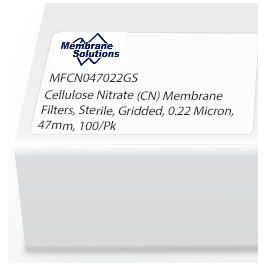
Sterlitech Sterile Cellulose Nitrate, MCE Membranes
 https://www.cotecno.cl/shop/sterlitech-sterile-cellulose-nitrate-mce-membranes-629523
https://www.cotecno.cl/web/image/product.template/629523/image_1920?unique=e74bbcc
https://www.cotecno.cl/shop/sterlitech-sterile-cellulose-nitrate-mce-membranes-629523
https://www.cotecno.cl/web/image/product.template/629523/image_1920?unique=e74bbcc
Descripción general
Sterlitech Sterile Cellulose Nitrate, MCE Membranes
Its features include high porosity, high protein binding can be blocked by pre-treatment or utilized in application, Triton-free, biologically inert with good thermal stability, and high degree of internal surface area for greater adsorption of product.
Preguntas frecuentes
MCE membranes feature fast flow rates, a high protein binding capacity, and great thermal stability, making them a staple for many environmental and biological laboratories. Furthermore, they are available as presterilized, individually wrapped membranes, and can include a gridded pattern for quantifying microbial growth.
The maximum operating temperatures for Sterlitech filter membranes are listed below.
- Sterlitech Silver Metal - 427°C
- Sterlitech Ceramic - 350°C
- Sterlitech Polycarbonate Track Etch - 140°C
- Sterlitech Polyester - 140°C
- Sterlitech Nitrocellulose (MCE) - 130°C
- Sterlitech Nylon - 180°C
- Sterlitech Polyethersulfone (PES) - *130°C
- Sterlitech Polypropylene - 82°C
- Sterlitech Cellulose Acetate - 135°C
- Sterlitech PTFE (Laminated) - 130°C
- Sterlitech PTFE (Unlaminated) - 260°C
- Sterlitech PVC Data not available
*5.0um and 8.0um - max temp is 180°C
Cellulose acetate (CA) and nitrocellulose (MCE) membranes will last 2 1/2 to 3 years before reverting to their natural hydrophobic states. Nylon, on the other hand, is naturally hydrophilic so it does not have a shelf life.
An easy test for older membranes is to perform a "wetting out" test. Dipping a small portion of the membrane into water (hydrophilic membranes) or an alcohol (hydrophobic membranes) works well. If the membrane absorbs the material, or "wets out", it has not gone past the shelf life.
Ideally, nitrocellulose (NC) membranes would be made entirely of nitrocellulose polymer. However, almost all commercially available filtration grade Filtros de membrana labeled as “nitrocellulose” are actually composed of membranes made with a mixture of nitrocellulose and cellulose acetate polymers. This is because pure nitrocellulose Filtros de membrana are very difficult to manufacture with acceptable characteristics.
In an effort to provide clarity to consumers, some manufactures refer to membranes containing a mixture of nitrocellulose and cellulose acetate polymers as mixed cellulose esters (MCE) membranes. In almost all filtration applications, mixed cellulose esters (MCE) Filtros de membrana are equivalent to nitrocellulose (NC) Filtros de membrana.
We have a Chemical Compatibility Chart that you can use for reference.
Sterile mixed cellulose esters (MCE) Filtros de membrana are used in vast quantities for microbiological studies across many industries and are manufactured in very high volumes to accommodate this demand. Economies of scale and process automation allow the sterile MCE Filtros de membrana to be offered at lower pack costs compared to non-sterile MCE Filtros de membrana. Non-sterile MCE filters are used much less frequently, necessitating less efficient, smaller volume manufacturing runs and packaging methods. Consequently, the non-sterile MCE Filtros de membrana have intrinsically greater manufacturing costs and must be offered at higher prices.
A. We have several membranes to recommend for gravimetric analysis.
- Mixed Cellulose Esters (MCE) Filtros de membrana, Plain: In gravimetric analysis using ashing techniques, (MCE) Nitrocellulose filters yield a residue of less than 0.045% of their initial Peso. They are hydrophilic with a non-cytotoxic wetting agent extractable level of less than 4% of their Peso.
- Polycarbonate Track-Etch Membranes (PCTE) - 25mm: Polycarbonate Track-Etch or our Polyester Track-Etch (PETE) membranes are two membranes that offer exceptionally low tare weights, are non-hygroscopic, and exhibit extremely low absorption and adsorption losses.
Since these membranes are non-hygroscopic, they are particularly well suited for gravimetric analysis. They do not require drying when used directly out of the package. If they are wet, they can be dried rapidly and will not pick up moisture from the air during weighing. - Glass Fiber Filters & Prefilters: Glass fiber filters without binders are recommended for analytical and gravimetric determinations.
Sample packs allow the customer to purchase small quantities of Filtros de membrana at nominal cost, with various diameters and pore sizes as selected. This allows the customer to preform trials as needed to determine the optimal filter for their application before committing to purchasing standard pack quantities.
| Especificación |
0.22 µm · 47 mm · pack 100 · MFCN047022GS
|
0.22 µm · 47 mm · pack 100 · MFCN047022S
|
0.45 µm · 47 mm · pack 100 · MFCN047045GWS
|
0.45 µm · 47 mm · pack 100 · MFCN047045S
|
0.8 µm · 47 mm · pack 100 · MFCN047080GWS
|
0.8 µm · 47 mm · pack 100 · MFCN047080WS
|
1 µm · 47 mm · pack 100 · MFCN047100GWS
|
1 µm · 47 mm · pack 100 · MFCN047100S
|
|---|---|---|---|---|---|---|---|---|
| Tamano de poro | 0.22 | 0.22 | 0.45 | 0.45 | 0.8 | 0.8 | 1 | 1 |
| Cuadricula | Yes | No | Yes | No | Yes | No | Yes | No |
| Diametro (mm) | 47 | 47 | 47 | 47 | 47 | 47 | 47 | 47 |
| Rejilla | Yes | No | Yes | No | Yes | No | Yes | No |
| Tamano de paquete | 100 | 100 | 100 | 100 | 100 | 100 | 100 | 100 |
| Variante | Tamano de poro | Cuadricula | Diametro (mm) | Rejilla | Tamano de paquete |
|---|---|---|---|---|---|
|
0.22 µm · 47 mm · pack 100 · MFCN047022GS
|
0.22 | Yes | 47 | Yes | 100 |
|
0.22 µm · 47 mm · pack 100 · MFCN047022S
|
0.22 | No | 47 | No | 100 |
|
0.45 µm · 47 mm · pack 100 · MFCN047045GWS
|
0.45 | Yes | 47 | Yes | 100 |
|
0.45 µm · 47 mm · pack 100 · MFCN047045S
|
0.45 | No | 47 | No | 100 |
|
0.8 µm · 47 mm · pack 100 · MFCN047080GWS
|
0.8 | Yes | 47 | Yes | 100 |
|
0.8 µm · 47 mm · pack 100 · MFCN047080WS
|
0.8 | No | 47 | No | 100 |
|
1 µm · 47 mm · pack 100 · MFCN047100GWS
|
1 | Yes | 47 | Yes | 100 |
|
1 µm · 47 mm · pack 100 · MFCN047100S
|
1 | No | 47 | No | 100 |